
Rug Fringe Repair and Replacement: When Fringes Can Be Secured, Repaired or Replaced
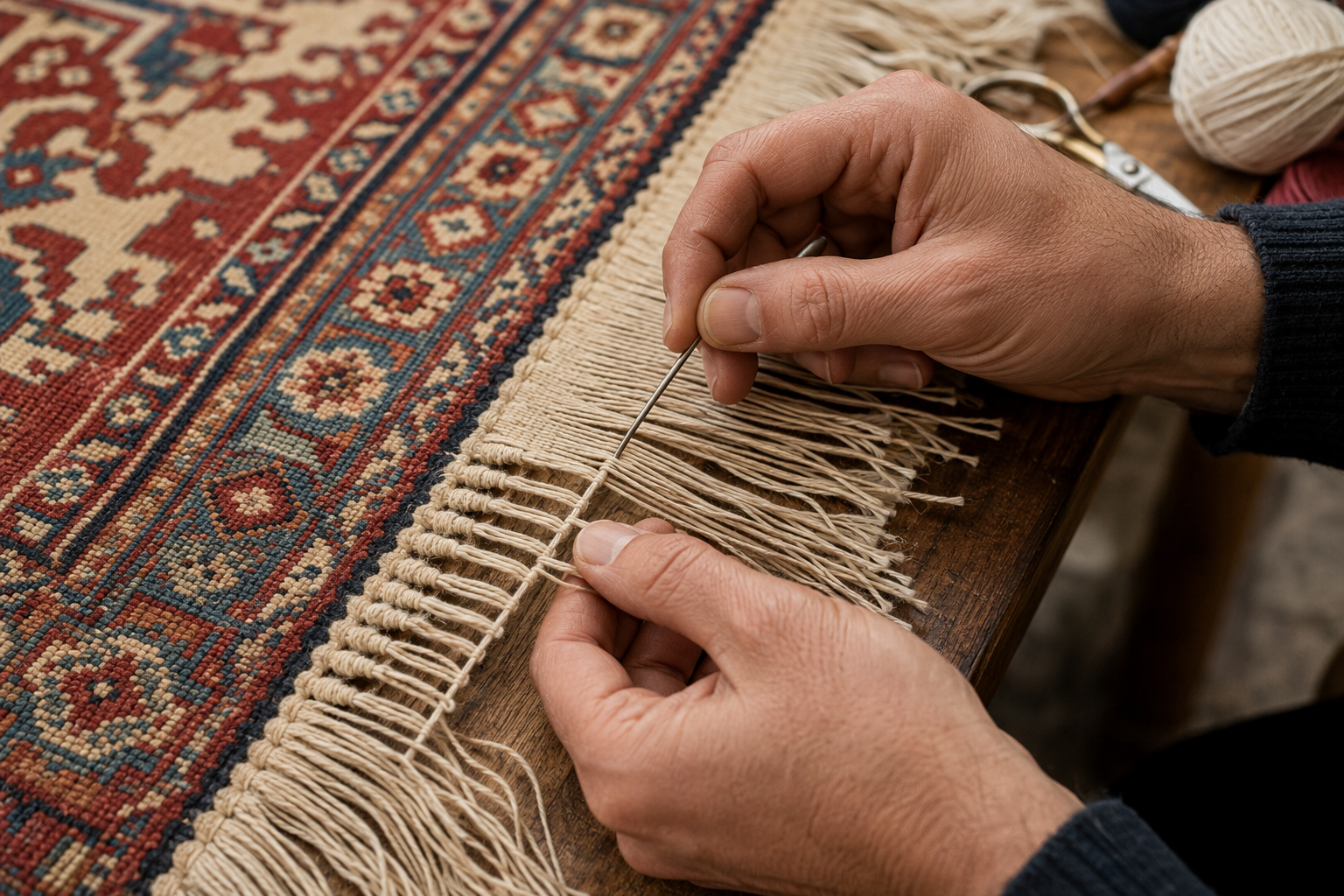
The fringes at the ends of a handmade rug are often treated as decorative tassels, but they usually have a much more important purpose. On many Persian, Oriental and other hand-knotted rugs, the fringes are visible extensions of the rug’s structural foundation. When they become loose, worn or damaged, the problem can gradually move into the woven body of the rug.
What may initially look like a few untidy tassels can therefore develop into lost knots, an uneven end, shortening of the rug or significant structural damage.
Professional rug fringe repair is intended to stabilise the rug, preserve its original construction and prevent deterioration from spreading. Depending on the type and severity of the damage, a specialist may recommend securing the existing fringes, reconstructing a damaged section, shortening and finishing the ends, or replacing the fringes more extensively.
At Rugmaster, we inspect each rug individually before recommending a treatment. The appropriate method depends on the rug’s construction, fibre, age, condition and the purpose of the repair. An antique Persian rug may require a different approach from a contemporary wool rug, a silk rug, a flatwoven kilim or a machine-made rug with decorative tassels.
This guide explains what rug fringes are, why they deteriorate, which repair methods may be appropriate and when professional intervention is recommended.
What Are the Fringes on a Handmade Rug?
To understand fringe repair, it helps to understand how a handmade rug is constructed.
A traditional hand-knotted rug begins with a foundation formed by vertical warp threads and horizontal weft threads. The pile is created by tying individual knots around the warp threads. As the rug progresses on the loom, rows of knots and wefts form its patterned surface.
At the two ends of many handmade rugs, the vertical warp threads continue beyond the woven section. These exposed foundation threads form the fringe.
This means that on many Persian and Oriental rugs, the fringe is not simply an accessory attached after weaving. It is part of the rug’s underlying structure.
When these foundation threads become weak or begin to break, the knots immediately next to them may lose their support. If the damage is left untreated, the end of the rug can begin to unravel row by row.
This is why damaged fringes should be assessed as a structural issue rather than only an aesthetic one.
Our wider rug repair and restoration service covers fringe damage alongside worn sides, holes, tears, moth damage, threadbare areas and other forms of deterioration.
Are Rug Fringes and Rug Tassels the Same Thing?
The terms “fringe” and “tassels” are often used interchangeably, but they do not always describe exactly the same construction.
On a traditional handmade rug, the fringe commonly consists of exposed foundation threads extending from the body of the rug. On some rugs, these threads may be knotted, plaited or otherwise finished.
On many machine-made or contemporary rugs, decorative tassels may instead be attached to the ends after the rug has been manufactured. In these cases, the tassels may not be structurally connected to the main foundation.
This distinction is important because the repair method will differ.
A specialist must first determine whether the damaged threads are:
- Part of the rug’s original structural foundation
- An applied decorative fringe
- A later replacement added during a previous repair
- A combination of original foundation threads and added finishing
- A decorative feature attached to a machine-made rug
A visually similar problem may therefore require very different treatment depending on how the rug was made.
Why Do Rug Fringes Become Damaged?
Fringes are exposed at the ends of the rug and receive little protection from surrounding pile. They are therefore particularly vulnerable to wear, friction, contamination and accidental damage.
Several factors may contribute to fringe deterioration.
Normal Foot Traffic
The ends of a rug are frequently walked over, particularly when the rug is placed in a doorway, hallway, sitting room or dining area. Repeated pressure and movement can gradually weaken, flatten and break the fringe fibres.
The central fringes may become shorter than those near the corners because the centre of the rug often receives the most traffic.
Vacuum-Cleaner Damage
Rotating vacuum brushes can catch loose threads and pull them into the machine. Even when the damage does not appear severe immediately, repeated contact may weaken individual strands and loosen the end finish.
Vacuuming directly over delicate fringes is especially risky on antique, silk or finely woven rugs. The main body of a suitable rug can usually be cleaned carefully, but the fringe should generally be handled separately and gently.
For broader maintenance advice, read our guide comparing professional rug cleaning with DIY rug cleaning.
Furniture and Door Movement
A fringe trapped beneath a heavy furniture leg can become compressed and distorted. Doors repeatedly opening across the end of a rug may also scrape and pull the fibres.
If a rug is too large for its location, continued friction may damage both its fringes and side edges. In some cases, professional alteration may be more appropriate than allowing the rug to deteriorate. Rugmaster provides specialist rug alterations and resizing as part of its restoration services.
Pets
Cats and dogs may claw, chew or pull at loose rug threads. Once an individual fringe thread has been lifted, it becomes easier for the pet to catch it again.
Pet urine can also weaken and discolour natural fibres if it reaches the ends of the rug. Affected rugs may require specialist cleaning and odour treatment before any structural repair is undertaken.
Incorrect Cleaning
Harsh chemicals, bleaching agents, aggressive scrubbing and unsuitable cleaning machinery can weaken fringe fibres. Cotton fringes may become brittle, discoloured or uneven after repeated exposure to inappropriate products.
Cleaning the fringe more aggressively than the rest of the rug can also create an unnaturally bright white finish that does not suit an older rug.
Professional rug cleaning should take the rug’s fibres, dyes, foundation and overall condition into account rather than treating every rug in the same way.
Moth or Insect Damage
Moth larvae and carpet beetle larvae can feed on susceptible natural fibres. Although cotton foundations are not their preferred food source, wool fibres, surface contamination and nearby pile may attract activity around the rug’s ends.
Damage may be more extensive than it first appears, particularly beneath furniture or on the underside of the rug. If insect activity is suspected, the problem should be treated before the fringe is restored.
Read our guide to moth-proofing and protecting rugs for additional information.
Age and Previous Repairs
Natural fibres weaken over time, especially when exposed to heavy use, moisture, dirt or earlier unsuitable treatments.
Some rugs also arrive at our workshop with old repairs made using glue, synthetic tape, machine stitching or mismatched materials. These additions may conceal the underlying damage while placing extra strain on the original foundation.
Previous repairs must often be carefully removed before a suitable restoration can begin.
Early Signs That a Rug Needs Fringe Repair
Fringe damage is usually easier to stabilise when it is identified early. Owners should inspect both ends of the rug periodically and look for changes.
Possible warning signs include:
- Individual threads becoming loose
- Knots at the ends of the fringe opening
- Fringes breaking at different lengths
- An uneven or scalloped end
- Small sections of the border beginning to disappear
- Pile knots becoming loose near the fringe
- Gaps forming between groups of fringe threads
- Previous stitching becoming detached
- Dark, stiff or brittle fibres
- Sections folding underneath the rug
- Tape, glue or fabric backing coming away
- A visibly weakened foundation at either end
A rug does not necessarily require complete refringing because a few threads are damaged. Early stabilisation may be sufficient to prevent the problem from developing.
However, once deterioration has entered the pile or outer border, more extensive reconstruction may be needed.
Photographs can provide an initial indication, but a physical inspection is the best way to assess the foundation, tension and condition of the fibres. You can submit photographs through our free rug quotation form.
The Difference Between Securing, Repairing and Replacing Rug Fringes
“Fringe repair” is a broad term covering several possible treatments. The correct option depends on how much of the original material remains and whether the rug’s foundation is stable.
1. Securing Existing Fringes
Securing is often appropriate when most of the original fringe remains but the end is beginning to loosen.
The objective is not necessarily to make every tassel identical. Instead, the priority is to prevent the weave from moving further into the rug.
The specialist may stabilise vulnerable foundation threads, secure the end rows and create a protective finish that supports the original structure.
This is generally less invasive than full reconstruction and may be suitable when:
- Damage has been identified early
- The foundation is largely intact
- Only a limited number of threads have broken
- The outer border has not been lost
- The owner wishes to preserve as much original material as possible
- The rug’s naturally aged appearance should be retained
For antique and collectable rugs, retaining sound original material is often preferable to unnecessary replacement.
2. Partial Fringe Reconstruction
Partial reconstruction may be appropriate when one area has deteriorated more severely than the rest.
A specialist may rebuild the missing foundation in the affected section and connect it securely to the surviving structure. The new work must be compatible with the rug’s weave, fibre, tension and appearance.
This approach may be used when:
- The centre of one end is badly worn
- A corner has lost its fringe
- A localised accident has damaged part of the end
- A pet has chewed one section
- Previous repair material has failed
- The surrounding original fringe remains serviceable
The aim is to avoid replacing more of the original construction than necessary while still producing a durable result.
3. Complete Fringe Replacement or Refringing
More extensive refringing may be recommended when the original fringe has largely disappeared, the foundation is severely weakened or an unsuitable previous fringe must be removed.
Depending on the rug, this may involve rebuilding or extending the foundation and creating a new fringe compatible with the original style.
Complete fringe replacement is not a single standard procedure. The appropriate materials and techniques will depend on whether the rug has a cotton, wool or silk foundation, how finely it is woven and how its original ends were finished.
Our professional fringe repair service includes detailed assessment before extensive work is recommended.
4. Shortening and Securing the Ends
Not every owner wants long fringes. In some cases, the surviving threads can be shortened evenly and the rug ends secured.
This option may be considered when:
- Long fringes are repeatedly becoming trapped or tangled
- The remaining fringe is untidy but structurally usable
- The owner prefers a shorter, cleaner finish
- The original construction permits safe shortening
- The end can be secured without harming the design
The fringe should never be cut without first considering its relationship to the foundation. Cutting structural threads too close to the body can allow the rug to unravel.
5. Removing an Unsuitable Previous Repair
Sometimes the first stage of fringe restoration is undoing earlier work.
Glue, adhesive tape, synthetic mesh, machine stitching or heavy fabric strips may have been added to stop the rug from unravelling. Although these methods may create a temporary visual improvement, they can harden the rug, trap contamination, interfere with cleaning and place uneven stress on the foundation.
A specialist may need to remove these materials carefully before the true condition of the rug can be assessed.
Can New Fringes Simply Be Sewn onto a Rug?
Decorative fringe can technically be attached to some rugs, but this does not necessarily repair structural damage.
If the foundation is already unravelling, sewing a fringe strip onto the end may conceal the problem without stabilising it. The original weave may continue to deteriorate underneath the added material.
An applied fringe can be suitable for certain machine-made or decorative rugs where the original tassels were also attached. It may also be used in specific restoration situations after the rug has been structurally secured.
The essential question is whether the treatment supports the original construction or merely covers the damaged area.
A proper assessment should determine:
- How the original fringe was formed
- Whether the foundation remains stable
- Whether any pile or border has already been lost
- Which material is compatible with the rug
- Whether an applied fringe would be appropriate
- Whether a more traditional reconstruction is justified
Cotton, Wool and Silk Rug Fringes
The rug’s foundation material significantly affects the complexity and cost of fringe restoration.
Cotton Fringe
Cotton is commonly used for the warp and weft foundations of Persian and Oriental rugs. It provides a strong, relatively stable structure and often appears as an off-white or cream fringe.
However, cotton can become brittle with age, moisture, contamination or harsh chemical treatment. Old cotton may look intact but break when placed under tension.
Replacement material should be selected with care so that it is compatible with the existing foundation.
Wool Fringe
Some tribal, nomadic and village rugs use wool foundations. Wool fringe may have a softer and less uniform appearance than cotton.
The repair should respect the character of the rug rather than making the end look unnaturally precise or modern. Fibre thickness, twist, colour and texture all influence the final appearance.
Our guide to tribal rug restoration explains why the individual construction of these rugs must be preserved.
Silk Fringe
Silk foundations are found in some particularly fine rugs. Their threads can be extremely delicate, and the rug may have a high knot density requiring precise restoration.
Silk fringe work is generally more time-consuming than a basic repair to a coarser wool rug. The fineness of the foundation, condition of the surrounding knots and availability of suitable materials must all be considered.
Silk rugs should not be entrusted to a general carpet repairer without relevant experience in fine handmade textiles.
Why Knot Density Matters During Fringe Restoration
On a hand-knotted rug, the fineness of the weave affects how the foundation must be reconstructed.
A coarsely woven tribal rug has a different structure from a finely knotted Persian city rug. The spacing of the warp threads, the number of knots, the fibre thickness and the tension must be considered when rebuilding a damaged end.
For more extensive restoration, the rug may be mounted so that missing foundation threads can be reconstructed and connected to the sound original material. The pile and pattern may then be rewoven where necessary.
The aim is not simply to add tassels. It is to restore structural continuity while respecting the rug’s original construction.
You can see an example of this approach in our Pakistani Bokhara fringe restoration case study.
Does a Rug Need to Be Cleaned Before Fringe Repair?
In many cases, professional cleaning is recommended before restoration begins.
Years of dry soil, dust, oils, spills and household contamination can become embedded in the rug and around the damaged foundation. Repairing over this contamination may make it harder to assess the true colours and condition of the fibres.
Cleaning before repair can provide several benefits:
- Dry soil is removed before the rug is handled extensively
- The true colours become easier to assess
- Replacement wool or thread can be matched more accurately
- Odours and contamination can be addressed
- Moth activity can be treated
- The foundation can be inspected more clearly
- Existing stains are less likely to interfere with restoration
- The completed repair does not immediately require another wash
However, the rug must be assessed before washing. A severely weakened end may need temporary stabilisation so that it can be cleaned safely.
At Rugmaster, the cleaning method is selected according to the rug’s construction, dyes and condition. Our specialist rug cleaning process includes inspection, dust extraction, controlled washing, rinsing, water extraction, drying and final grooming.
Proper drying is equally important. Read more about why controlled air drying matters for Persian rugs.
How Professional Rug Fringe Repair Is Carried Out
Every rug requires an individual repair plan, but the professional process commonly includes the following stages.
Initial Inspection
The rug is examined from the front and back. The specialist assesses:
- The rug’s likely origin and construction
- Foundation material
- Pile fibre
- Knot density
- Dye stability
- Extent of fringe loss
- Condition of the end rows
- Previous repairs
- Moth or insect activity
- Moisture, staining or contamination
- Damage to the border or field
- Whether both ends require treatment
It is important to inspect the back because structural damage may be more visible there than from the pile side.
Documentation and Quotation
Photographs and measurements may be recorded before work begins. The owner should receive a clear explanation of the recommended treatment and its limitations.
Minor securing, partial reconstruction and complete refringing involve very different amounts of labour, so a quotation should be based on the individual rug rather than a single standard price.
Cleaning or Preparation
Where appropriate, the rug is professionally cleaned before restoration. Any dangerous loose areas may be temporarily protected first.
If cleaning is not necessary or has recently been carried out correctly, the repair may proceed after preparation and testing.
Removal of Failed Repairs
Unsuitable stitching, adhesive, tape or replacement material may be removed carefully. This stage can reveal additional damage that was previously concealed.
Structural Stabilisation
The remaining foundation and end rows are secured to prevent further movement. If foundation threads are missing, they may need to be reconstructed and integrated with the sound material.
Reweaving or Refringing
Where damage has entered the patterned area, missing knots or sections may be recreated using compatible materials.
For fringe replacement, the finishing method should reflect the rug’s original character wherever practical.
Trimming and Finishing
The repaired fringe may be aligned or trimmed to an appropriate length. It should not necessarily look artificially white or mechanically uniform, particularly on an older handmade rug.
Final Inspection
The completed work is checked for stability, alignment, tension and appearance. Both ends and adjoining edges should be reviewed before the rug is returned.
Examples of completed restoration projects can be viewed in the Rugmaster fringe repair gallery and wider rug restoration case studies.
Can Persian Rug Fringes Be Restored Invisibly?
The achievable result depends on the amount of surviving original material, the age of the rug and the severity of the damage.
A carefully completed repair can blend very well with the surrounding construction, especially when suitable fibres and techniques are used. However, it is not always responsible to promise that every restoration will be completely invisible.
Several factors affect the final appearance:
- Ageing and oxidation of the original fibres
- Changes in colour caused by sunlight
- Previous chemical treatments
- Unusual or unavailable materials
- Severe loss of the original pattern
- Differences between old and new fibre
- Extremely fine knotting
- Earlier alterations to the rug
- Uneven wear across the two ends
For some antique rugs, a sympathetic and structurally sound repair is more appropriate than trying to make the end look newly manufactured.
The objective should be to preserve the rug’s integrity and visual balance while avoiding unnecessary loss of original material.
How Much Does Rug Fringe Repair Cost?
The cost of fringe repair cannot be determined accurately by the rug’s dimensions alone.
A small silk rug with a very fine, badly damaged foundation may require more detailed work than a much larger but coarsely woven wool rug.
Factors affecting the quotation include:
- Whether the rug is handmade or machine-made
- Foundation material
- Fibre type
- Knot density
- Length of the damaged end
- Whether one or both ends require work
- Whether the damage has entered the border
- Amount of missing foundation
- Condition of the original fringe
- Presence of glue or previous repairs
- Whether cleaning is required
- Whether moth treatment is needed
- Complexity of colour and pattern matching
- Type of finish requested
- Overall age and fragility
Clear photographs can help us provide an initial assessment. Useful images include:
- One full photograph of the entire rug
- A close-up of each damaged end
- A photograph of the back of the damaged area
- Close-ups of any loose knots or missing border
- Photographs of earlier repair work
- The rug’s full dimensions
For an accurate quotation, submit the details through our rug fringe repair enquiry form.
Is Rug Fringe Repair Worth Doing?
Whether restoration is worthwhile depends on more than resale value.
A rug may justify repair because it is:
- Handmade and of good quality
- Antique or collectable
- Part of a family collection
- Sentimentally important
- Difficult to replace
- Well suited to a particular room
- Structurally sound apart from its ends
- Valuable enough to preserve
- A piece of cultural or artistic craftsmanship
In other cases, an extensive restoration may cost more than the rug’s open-market value. A reputable specialist should explain the available options so that the owner can make an informed decision.
For rugs of uncertain origin or value, a professional rug valuation may be useful. Insurance value, retail replacement value and resale value are different considerations, so the purpose of the valuation should be made clear.
Rugmaster also provides broader answers to common ownership questions in our rug care FAQs.
Can You Repair Rug Fringes at Home?
Minor tidying may appear straightforward, but structural fringe repair is generally not a suitable DIY project.
Common home-repair mistakes include:
- Cutting the fringe too close to the pile
- Using household glue
- Attaching adhesive carpet tape
- Machine-stitching through the foundation
- Pulling loose threads
- Bleaching discoloured cotton
- Scrubbing with a stiff brush
- Using mismatched synthetic thread
- Folding the damaged end underneath the rug
- Continuing to vacuum over loose areas
These methods may disguise the problem temporarily while making later restoration more difficult.
Until the rug can be inspected, safer precautions include keeping the damaged end away from foot traffic, avoiding vacuuming directly over it and preventing pets or furniture from catching loose threads.
Do not pull an exposed thread to see where it leads. A thread that appears isolated may be connected to a larger part of the foundation.
How to Protect Rug Fringes After Repair
A high-quality repair should be supported by sensible maintenance.
Vacuum Carefully
Avoid allowing a rotating brush to run over the fringes. Clean the pile according to the rug’s construction and treat the fringe gently.
Rotate the Rug
Rotating the rug periodically can distribute wear more evenly, particularly in busy rooms.
Use Suitable Underlay
A correctly selected rug underlay can reduce movement, rippling and unnecessary friction. A moving rug is more likely to catch against furniture, doors and footwear.
Adjust Furniture Placement
Avoid placing narrow or sharp furniture feet directly on the fringe. Make sure chairs do not repeatedly drag across the rug’s ends.
Deal With Spills Promptly
Blot spills rather than rubbing them. Seek professional advice for contamination involving urine, oil, wine or cleaning chemicals.
Inspect Areas Under Furniture
Moth and insect activity often develops in dark, undisturbed sections. Lift and inspect the rug periodically, including its ends and underside.
Arrange Periodic Professional Cleaning
Embedded grit can act abrasively within the pile and foundation. Appropriate professional cleaning helps remove contamination and provides an opportunity for developing damage to be identified.
Fringe Damage Versus Side-Edge Damage
The fringes are located at the ends of the rug, while the long sides are usually protected by wrapped or overcast edges. These side finishes are sometimes called selvedges or side cords.
Although both problems may appear to involve loose thread, they require different repairs.
Fringe damage commonly affects the warp ends and end rows. Side damage may involve:
- Worn overcasting
- Exposed foundation
- Broken side cords
- Curling edges
- Loss of pile beside the edge
- Previous machine binding
- Friction from foot traffic or furniture
A rug with damaged fringes should therefore also be checked along both sides. Deterioration at the corners can affect the end and side simultaneously.
Our complete Persian and Oriental rug repair service covers fringe securing, side repair, hole reconstruction, pile restoration and other structural work.
What Types of Rugs Can Have Their Fringes Repaired?
Fringe work may be undertaken on many types of rugs, including:
- Persian rugs
- Oriental rugs
- Turkish rugs
- Afghan rugs
- Pakistani rugs
- Bokhara rugs
- Caucasian rugs
- Tribal rugs
- Wool rugs
- Silk rugs
- Wool-and-silk rugs
- Antique rugs
- Contemporary handmade rugs
- Flatweaves and kilims
- Aubusson and tapestry-style textiles
- Selected machine-made rugs
The method depends on the construction rather than the marketing name alone. Two rugs described as “Persian style” may have entirely different foundations and repair requirements.
Rugmaster’s comprehensive guide to Oriental rug repairs explains additional terminology and restoration methods.
Why Early Fringe Repair Is Important
The most important reason to repair damaged fringes promptly is to prevent progressive loss.
Once the securing finish at the end has failed, everyday movement can loosen the next row. The damage may then progress from the fringe into the outer border.
At that point, restoration may require:
- Rebuilding foundation threads
- Recreating missing knots
- Matching several pile colours
- Reconstructing part of the border
- Correcting an uneven end
- Removing failed previous repairs
- Carrying out work across a larger area
Early securing may preserve more original material and reduce the scale of the eventual restoration.
A useful principle is simple: if threads are actively loosening, the rug should be inspected before more material is lost.
Choosing a Rug Fringe Repair Specialist
Fringe restoration requires an understanding of rug construction, not only general sewing or carpet fitting.
Before authorising work, consider asking:
- Does the company specialise in handmade rugs?
- Will the rug be inspected from both sides?
- Can they distinguish structural fringe from decorative tassels?
- Will they explain whether the work is securing, reconstruction or replacement?
- Can they assess wool, cotton and silk foundations?
- Will existing original material be preserved where practical?
- Can they identify unsuitable previous repairs?
- Is professional cleaning available where needed?
- Can they show relevant restoration examples?
- Will the quotation explain the proposed work?
- Is collection and delivery available?
- Can they advise on aftercare?
At Rugmaster, our team provides specialist rug cleaning, rug repair and restoration, fringe repairs and rug valuation, allowing the rug to be assessed as a complete textile rather than treating one visible symptom in isolation.
Customer experiences can also be viewed on our testimonials page.
Frequently Asked Questions About Rug Fringe Repair
Can badly damaged rug fringes be restored?
In many cases, yes. The appropriate treatment depends on how much of the original foundation survives and whether the damage has reached the pile or border. Minor damage may only require securing, while extensive loss may require foundation reconstruction and refringing.
Should all the old fringe be removed?
Not necessarily. Sound original material should generally be retained where practical. Complete removal may be appropriate when the original fringe has failed extensively or when an unsuitable previous repair needs to be replaced.
Can I cut untidy rug fringes shorter?
Cutting may cause further unravelling if the fringe forms part of the foundation. The end should be inspected and secured appropriately before any significant shortening.
Why are my rug fringes different lengths?
Uneven length may result from foot traffic, vacuum damage, age, pets or earlier trimming. It can also indicate that the rug has started to lose foundation threads unevenly.
Can you make rug fringes perfectly white?
Fringes can often be improved during professional cleaning, but aggressive bleaching may weaken fibres and create an unnatural appearance. The safest result depends on the fibre, age and condition of the rug.
Can just one damaged section be repaired?
Yes, partial repair may be possible when the surrounding foundation remains sound. The specialist must ensure that the new section connects securely to the original construction.
Can the fringes be removed completely?
In some cases, the visible fringe can be shortened and the ends secured. Complete removal without structural finishing is unsafe on rugs where the fringe forms part of the foundation.
How long does fringe repair take?
The timescale depends on the type and extent of the work. Straightforward securing may be completed more quickly than foundation reconstruction, detailed reweaving or silk-fringe restoration. An estimated completion period should be provided after inspection.
Do both ends need to be repaired?
Not always. However, both ends should be inspected because they may have experienced similar wear. In some cases, treating both ends provides a more balanced and preventative result.
Can a machine-made rug have new tassels fitted?
Potentially, yes. Applied decorative tassels may be replaced on certain machine-made rugs, although the construction must first be checked. This is different from reconstructing the foundation of a hand-knotted rug.
Is cleaning always necessary before repair?
Not in every case, but it is often recommended. Cleaning allows contamination to be removed and makes accurate assessment and colour matching easier. A recently and correctly cleaned rug may not need washing again.
Will fringe repair increase the rug’s value?
A well-executed repair can preserve condition and prevent further loss, but it does not automatically increase market value. The effect depends on the rug’s quality, age, rarity, condition and the standard of restoration.
Request a Rug Fringe Repair Assessment
Loose, uneven or missing fringes should not be ignored. The earlier the damage is stabilised, the greater the chance of preserving the rug’s original foundation and avoiding more extensive reconstruction.
Rugmaster provides professional fringe repair for Persian, Oriental, antique, tribal, wool, silk and contemporary handmade rugs. Depending on the condition of the rug, we can assess whether its fringes should be:
- Carefully secured
- Partially reconstructed
- Shortened and finished
- Refringed
- Restored alongside damaged pile or borders
- Cleaned and treated before repair
To obtain an initial assessment, send us photographs showing the complete rug, both ends, the back of the damaged area and any previous repairs.
Request a free rug fringe repair quotation, call 0208 341 9191, or visit Rugmaster at 24 Aylmer Parade, Highgate, London, N2 0PE.
For related services, explore:
- Professional rug repair and restoration
- Specialist Persian and Oriental rug cleaning
- Rug valuation services
- Fringe restoration case studies
- Completed fringe repair gallery
- Expert rug care FAQs
A damaged fringe does not necessarily mean that a rug is beyond saving. With the correct assessment and a repair suited to its original construction, the rug can often be stabilised, improved and protected for many more years of use.